
a homeowner's field guide
Home Standby Generator Installation in Ottawa: 2026 Guide
An Ottawa-area homeowner guide to generator sizing, installation costs, transfer switches, ESA notifications, gas or propane work, City rules and contractor questions.
13 min readEditorially reviewed
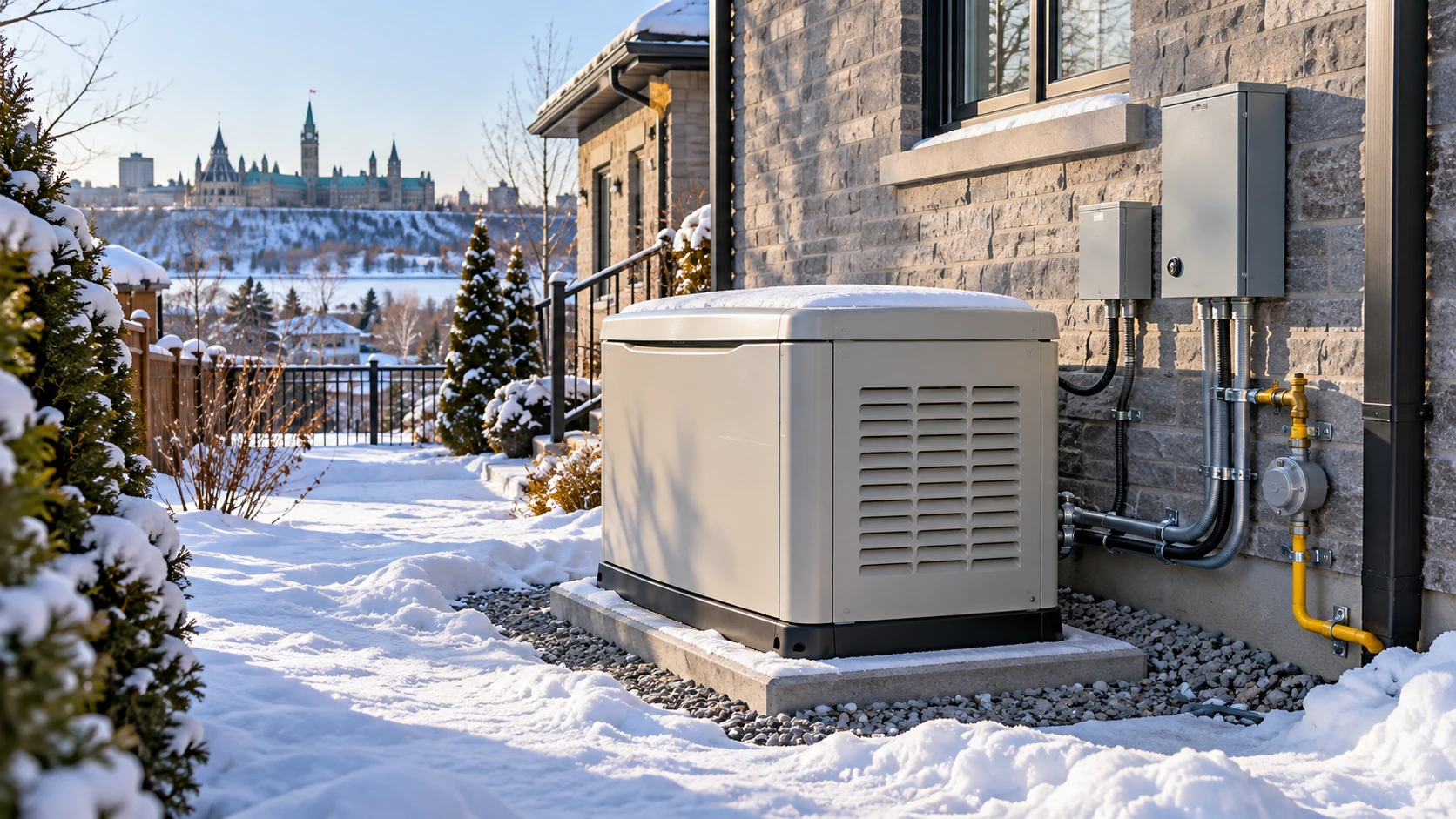
A home standby generator can restore selected household circuits—or much of a home—automatically during an outage. But the generator itself is only one part of the project. Ottawa-area homeowners also need a correctly sized electrical design, a safe transfer device, an approved outdoor location, fuel supply, qualified installers and commissioning tests.
The short version: Start with a list of loads you truly need during an outage. Hire an Ontario Licensed Electrical Contractor (LEC) to assess the electrical design and ESA notification. If the system uses natural gas or propane, arrange qualified fuel-system work through the appropriate registered contractor. Confirm placement and local rules before buying equipment. Never connect a generator in a way that can energize utility lines. See the Electrical Safety Authority's generator safety guidance.
Scope and date: Researched for Ottawa-area homeowners, October 15, 2026. City of Ottawa rules discussed here apply inside City of Ottawa boundaries. Properties in Carleton Place, Mississippi Mills or other neighbouring municipalities can have different zoning and local requirements. Prices are planning examples from published contractors, not an Ottawa price survey or a quotation for your home.
1. Decide what must keep running in an outage
Before asking about generator kilowatts, make a practical outage plan. A home with natural-gas heat, municipal water and a few essential circuits has different needs from a rural home with a well pump, septic equipment, electric heat and a sump pump.
| Household load | Why it matters | What the installer should verify |
|---|---|---|
| Furnace blower or heat-pump system | Heat during winter outages | Starting load, controls and whether backup heat is electric |
| Refrigerator, freezer and food storage | Food safety | Startup surge and which outlets are connected |
| Sump pump | Basement-flood prevention | Pump starting current, simultaneous loads and battery backup |
| Private well pump | Water supply at rural properties | Pump voltage, horsepower and motor starting current |
| Septic pump or controls, if present | Wastewater management | Whether the property has an electrically powered system |
| Internet, phones, lights and receptacles | Basic communication and living needs | Selected circuits rather than every receptacle |
| Air conditioning, electric cooking, EV charger | Large discretionary loads | Whether to omit, shed or explicitly include them in sizing |
Key distinction: A generator advertised as “whole-home” may still need load management. Large heating, cooking and charging loads can exceed its output if they all start or operate together. Ask the contractor to provide the calculated demand, starting loads and any automatic load-shedding strategy in writing.
A rural Ottawa household should explicitly mention well-water pressure, sump-pump operation, heating controls, driveway access in winter and whether the generator's propane supply must support an extended outage. Ontario's power-outage guidance specifically mentions backup power for private well pumps.
2. Standby, portable or battery backup: compare the alternatives
A permanently installed standby system is convenient, but not every household needs one. Consider the equipment, manual effort, fuel and essential loads together.
| Option | What it does | Important limitation |
|---|---|---|
| Automatic standby generator | Fixed outdoor engine; usually starts and transfers selected loads automatically | Higher purchase/installation cost; fuel and maintenance required |
| Portable generator with an approved connection arrangement | Can supply selected loads while someone sets it up and operates it safely outdoors | Manual setup, refuelling and outage-time attention; connection must prevent backfeed |
| Battery or inverter-based backup | Can provide quiet, immediate backup to selected loads | Stored energy and duration may be limited; large heating loads are costly to cover |
| Sump-pump battery backup | Protects a narrow, high-priority load | Does not power the rest of the home and has finite runtime |
Do not backfeed the house. Never improvise a connection through a dryer outlet, exposed conductors or a homemade adapter. ESA says permanently connected generator systems require a proper transfer device so generator power cannot flow back into the utility system. ESA's guidance is the starting point.
If you're comparing a meter-base plug-in transfer device with a conventional transfer switch, don't assume every product is allowed by your electricity distributor. ESA's May 2026 Bulletin 2-33-0 discusses approved devices, distributor requirements and a narrow notification exemption for the device itself when installed by an LEC. Hardwiring a generator to a transfer switch still requires an ESA notification. Have your LEC and the serving utility confirm the intended arrangement. Read the ESA bulletin.
3. How much does a standby generator installation cost in Ottawa in 2026?
For an initial budget, roughly $8,000–$25,000 or more installed is a broad range appearing across 2026 contractor-published Ontario and Ottawa examples. It is not a verified median for Ottawa, a municipal price schedule or an estimate for your property. Actual projects can fall below or above it; one contractor quotes $8,000–$18,000 for many Ontario standby systems while other local published examples extend to $30,000-plus for larger or complex installations. See the Ontario contractor cost guide and a separate Ottawa contractor pricing example. These are commercial estimates, not independent market research.
Compare the complete installed scope, not just the generator's online price.
| Quote component | Questions to ask before comparing prices |
|---|---|
| Generator and capacity | Exact manufacturer/model, continuous output and fuel type? |
| Transfer equipment | Automatic transfer switch, essential-circuit panel, load shedding or meter-base device? |
| Electrical installation | New breakers, wiring, conduit, grounding/bonding, shutdown coordination and ESA notification? |
| Fuel installation | Gas line size, distance, regulator, meter capacity, propane tank and certified gas work? |
| Site work | Pad, grading, snow access, trenching, excavation or restoration? |
| Permits and approvals | Who obtains ESA notification, distributor authorization and any required municipal approvals? |
| Startup and handover | Commissioning, simulated outage, operating demonstration, documentation and warranty registration? |
| After-sales costs | Scheduled service, batteries, winter maintenance, call-out fees and warranty exclusions? |
A small essential-load installation with easy fuel and electrical access is not directly comparable to a large home requiring trenching, fuel-system upgrades or multiple high-demand appliances. Request at least two or three itemized site-specific quotes where practical.
What is the ESA fee in 2026?
ESA's 2026 Residential Fees Quick Reference Guide, effective April 1, lists its contractor reference fee for a generator and transfer switch inspected together as $86 plus $30; when inspected separately it lists $172. Different non-contractor rates apply, and other work or visits can change the fee. This is only an ESA reference fee, not the installation labour, fuel work, municipality fees or total permit budget. Ask the contractor what is actually included in your quote. ESA 2026 fees (PDF).
4. Electrical rules: licensed contractors, notifications and transfer equipment
In Ontario, an electrical business offering electrical work to homeowners generally must hold an ECRA/ESA Licensed Electrical Contractor licence. Check the business licence, not just an individual worker's electrician or Master Electrician credentials. ESA provides a licensed-contractor verification service.
ESA's generator safety page states that permanently connecting a generator to home wiring requires a transfer device and an ESA notification of work. Ask your LEC to explain who files the notification, what stages of inspection or review may apply, and what completion documents you should receive.
Questions to ask the electrical installer:
- What is your business's ECRA/ESA licence number, and can I verify it?
- Which circuits and loads are covered, and how was starting current considered?
- What approved transfer arrangement prevents utility backfeed?
- Who coordinates any utility isolation, meter work or reconnection?
- Who files the ESA notification, and is that fee in the quote?
- How will you test both outage transfer and return to utility power?
- Will I receive a commissioning record, equipment manuals and relevant ESA completion documents?
Don't confuse an ESA electrical notification with a municipal building or zoning approval. They serve different purposes. An LEC should tell you what electrical work it is responsible for; the municipality may need to advise on siting and other local permissions.
5. Natural gas or propane: confirm the fuel design
Most conventional home standby units use natural gas or propane, but availability depends on the property. A home on a gas main can face meter or piping-capacity questions; a rural property with propane needs tank sizing, delivery access and appropriate regulation for the generator's fuel demand.
In Ontario, TSSA registers contractors and certifies technicians working on regulated fuel equipment. For the fuel connection, ask for a suitable TSSA-registered fuels contractor and technicians certified for the work. Don't assume the electrical contractor's licence authorizes gas piping; some firms coordinate both trades. Use TSSA's contractor and technician overview and registered fuels-contractor directory.
| Natural gas | Propane |
|---|---|
| May be convenient where the home already has suitable service | Often relevant to homes beyond the natural-gas network |
| Confirm meter capacity, pressure and new-piping requirements | Confirm tank capacity, regulator, line routing and delivery arrangements |
| Fuel supply can still be interrupted; do not assume it is guaranteed | Runtime depends on usable on-site fuel and generator load |
| Ask who coordinates utility or gas-provider work | Ask who owns/services the tank and clears delivery access after snow |
Ask for the installation's expected fuel consumption at representative loads, not just a headline number of days of backup. Actual runtime and cost depend on load, weather, maintenance and fuel availability.
6. Where can the generator go on an Ottawa property?
Placement is a safety and local-compliance issue, not just a landscaping preference. A generator produces carbon-monoxide-containing exhaust, heat and noise. Its exact location must satisfy the equipment manufacturer's installation instructions, fuel and electrical requirements, service clearances, and applicable municipal rules.
The City of Ottawa's Zoning By-law 2026-50, Part 2, Section 204 includes provisions for permanent generators in residential settings. The published provisions identify emergency/blackout use, a 0.3-metre minimum lot-line setback in the specified residential cases, and a 1-metre maximum projection. These are zoning provisions, not an all-purpose generator-to-window or generator-to-wall clearance. Do not design a location from the 0.3-metre figure alone. The exact site conditions and all other relevant requirements still need review. City zoning provisions.
Ottawa's Noise By-law 2017-255 also addresses generators. Section 6 includes a 50 dB(A) limit at the point of reception for the devices it covers and specifies an emergency exception for portable generators. Do not assume that exemption applies to a permanently installed standby unit or routine exercise runs. Have the installer confirm how testing and location fit the by-law.
Site checklist:
- Ask the City about the applicable zoning provisions and whether any separate municipal approval is needed for your exact proposed work; don't assume that ESA notification answers the municipal question.
- Confirm manufacturer-required clearances to windows, doors, vents, walls, combustible materials and mechanical equipment.
- Keep engine exhaust away from building openings, neighbouring homes and air intakes.
- Plan for snow drifting, roof runoff, icy access and service visits in Ottawa winters.
- Account for drainage, yard grade, flood-prone spots and pad stability.
- Confirm underground service routes and whether trenching or gas-pipe changes affect the project.
- Discuss generator test-cycle noise with close neighbours before finalizing the spot.
Municipal boundary matters. Ottawa's zoning and noise rules do not automatically apply to a house in Mississippi Mills, Carleton Place or another municipality just because a contractor advertises “Ottawa generator installation.” Ask your municipality about its own rules.
7. Carbon monoxide and outage safety
Never install or operate a combustion-engine generator inside a house, basement, garage or enclosed porch—even with a door or window open. The ESA and the Government of Ontario both warn about potentially fatal carbon monoxide (CO).
Ontario's CO alarm rules changed January 1, 2026. For homes that meet the triggering conditions (including having a fuel-burning appliance, fireplace or attached garage), the province requires CO alarms adjacent to sleeping areas and on every storey. Consult Ontario's current CO guidance for the details and your home's circumstances. Test and maintain alarms according to their instructions.
If a CO alarm sounds, leave the home immediately and call 9-1-1 from outside. Do not try to troubleshoot a running generator while occupants may be exposed. A standby generator can fail to start or deliver power; families should still keep a separate emergency plan, charged communication devices and an alternative place to go if necessary.
8. How a proper installation should proceed
- Set an outage goal. Essential circuits, high-priority medical or accessibility needs, well or sump pumps, or an appropriately designed whole-home arrangement.
- Have an LEC assess the loads. Ask for a written sizing rationale, including motor starting currents and any load-management plan.
- Choose the fuel option. Confirm suitable natural-gas capacity or propane storage and fuel contractor responsibilities.
- Confirm the site location. Review equipment clearances, Ottawa zoning and noise rules, site drainage, winter access and utility coordination.
- Obtain itemized proposals. Compare the same scope: generator, transfer equipment, electrical and fuel work, pad, permits, commissioning and service.
- Have contractors arrange required notifications and approvals before work. Ask who is accountable for each item and what the inspection sequence will be.
- Complete and commission the system. Expect an installer-run functional test, including safe transfer between utility and generator power, and verification of selected loads.
- Receive a handover package. Keep permits and notifications, relevant ESA documents, gas-service records, warranty, manuals, commissioning notes and support contacts.
- Plan maintenance. Follow the manufacturer's schedule for checks, oil/filter service where applicable, starting battery, test runs and snow clearing.
Do not attempt the transfer-switch, panel, gas or generator connection work yourself based on an online article. The purpose of this checklist is to help you choose and supervise qualified trades—not to replace an electrical or fuel-system design.
9. What to look for in an Ottawa generator quote
A useful quote should make you confident that the system will actually support the loads you expect when the utility goes out, not simply that a generator will be delivered to your driveway.
| Compare the proposals on… | Ask this exact question |
|---|---|
| Backup scope | “Which circuits or loads will work during an outage, and which will not?” |
| Capacity | “Can you show the sizing calculation and starting-load assumptions?” |
| Utility interface | “What prevents backfeed, and which utility approvals or shutdowns are needed?” |
| Fuel scope | “Is the gas or propane work included, and who is TSSA-registered?” |
| Outdoor placement | “Who confirms the site meets the manual, City rules and noise requirements?” |
| Compliance | “Who files the ESA notification and provides completion paperwork?” |
| Tests | “Will you simulate an outage and demonstrate automatic transfer and retransfer?” |
| Service | “Who responds if it won't start after installation, including outside business hours?” |
Warning signs: a contractor who will not provide an ECRA/ESA licence number for the electrical work; unclear gas-trade qualifications; a promise that no transfer device is needed for a wired-in standby generator; vague “whole house” marketing without a load list; or a price that omits the fuel connection, commissioning or inspection details. Stop and clarify before signing.
10. Special considerations for rural Ottawa-area homes
Rural properties may be excellent candidates for backup power because an outage can affect not only lights and refrigeration but also well-water supply, sump pumping and some wastewater systems. Rural installations can also introduce longer cable or fuel runs, propane delivery constraints and snow-access challenges.
| Rural question | Why to ask |
|---|---|
| Is the property served by Hydro Ottawa, Hydro One or another distributor? | Utility meter/connection requirements and approval process can differ |
| Does the well pump require 240 V or have a high motor starting current? | Can materially affect system sizing |
| Are electric heat, heat pumps or auxiliary resistance heaters present? | May require load management or a larger system |
| Is there propane delivery access after a snowstorm? | A backup system only runs while usable fuel is available |
| Can the generator be serviced without walking through deep snow or floodwater? | Winter service access and safe inspection matter |
| Is the home outside City of Ottawa limits? | Check the correct municipality's placement and noise rules |
For Ottawa-area homeowners, the best-value system often comes from prioritizing a few essential loads rather than paying to operate every high-demand appliance simultaneously. But the answer is house-specific; have a qualified installer produce a written design.
11. Save this homeowner's generator checklist
Before you request estimates:
- List essential loads: heat controls, refrigeration, sump or well pump, internet, lighting and accessibility needs.
- Note whether your property has natural gas, propane or another viable fuel arrangement.
- Confirm municipal boundaries and the serving electricity distributor.
- Identify possible outdoor locations but don't assume a space meets all required clearances.
- Ask at least two qualified contractors for comparable, detailed proposals.
Before signing:
- Verify the electrical business's ECRA/ESA licence.
- Identify the qualified TSSA-registered fuels contractor for gas or propane work.
- Check the circuit list, load-management assumptions and transfer equipment model.
- Confirm who handles ESA notification, municipal questions and utility coordination.
- Ensure site work, startup, commissioning and warranty service are described in writing.
At handover:
- Observe the installer demonstrate a safe simulated outage and return to utility power.
- Obtain equipment models, operating instructions and maintenance schedules.
- Save relevant ESA and fuel-work records, invoices, tests and warranty documents.
- Confirm CO alarms and emergency procedures with all household members.
Official starting points: ESA generator safety, verify an Ontario electrical contractor, TSSA fuels-contractor information, City of Ottawa zoning rules.
Editorial note (reviewed October 15, 2026): This guide offers general homeowner information, not electrical design, fuel-system instructions, code interpretation or a site-specific permit determination. Equipment specifications, provincial requirements and City rules can change. Confirm your installation with your Licensed Electrical Contractor, qualified fuel contractor, electricity distributor and municipality before work begins. Listed costs are commercial examples, not guaranteed Ottawa prices.
you asked
Common questions
How much does a whole-home standby generator cost in Ottawa in 2026?
For early budgeting, published Ontario and Ottawa contractor examples span roughly $8,000–$25,000 or more installed, and some complex whole-home installations exceed that. This is not an independently verified Ottawa average. Obtain a site-specific, itemized quote covering the generator, transfer equipment, wiring, fuel connection, pad, notifications and commissioning.
Do I need an electrical permit or ESA notification for a standby generator in Ontario?
ESA says permanently connecting a generator to home wiring requires a transfer device and a notification of work. An Ontario Licensed Electrical Contractor should explain and arrange the notification and any applicable inspections. A municipal building or zoning requirement is a separate question to confirm for the site.
Can I plug a generator into a dryer outlet to power my house?
No. Do not use a dryer outlet, improvised adapter or other backfeeding arrangement. A properly approved transfer device isolates generator power from the utility and protects occupants and utility workers. Ask an Ontario Licensed Electrical Contractor about permitted options.
Does an Ottawa home standby generator need a transfer switch?
Permanently connected systems require an approved transfer device. The exact equipment may be a conventional automatic transfer switch or another permitted configuration. A meter-base plug-in device has specific approval and distributor requirements, and ESA’s May 2026 bulletin distinguishes its limited notification exemption from hardwiring a generator, which still requires notification.
Are standby generators allowed beside a house in Ottawa?
Placement depends on City zoning, equipment and fuel clearances, electrical safety, exhaust direction and noise. Ottawa Zoning By-law 2026-50 contains specific provisions for permanent generators, but the local lot-line figure is not a safe shortcut for exhaust or window clearances. Confirm the proposed location with the installer and the City.
Do I need a licensed gas fitter for a natural-gas or propane generator?
Fuel piping and regulated fuel equipment work should be handled by the appropriately qualified technician working through a TSSA-registered fuels contractor. The electrical installer may coordinate the work but an ECRA/ESA licence alone does not authorize every type of fuel connection.
What generator size is right for a well pump, furnace and sump pump?
There is no universal size for those three loads. An installer must check voltages, motor starting currents, concurrent operation, controls and whether electric heating or other large loads must run. Ask for a written sizing rationale and list of circuits supported.
Will a standby generator start automatically if the power goes out?
An automatic standby installation is intended to detect an outage, start the generator and transfer designated loads, subject to system conditions. It still needs maintenance and can fail. At commissioning, ask the installer to demonstrate an outage simulation, retransfer and which circuits actually receive power.
How close can I install a standby generator to the property line in Ottawa?
The City’s 2026 zoning provisions include a 0.3-metre minimum lot-line setback in specified residential cases, along with other conditions. That number does not replace the manufacturer’s ventilation, combustion-exhaust and service clearances. Confirm the complete site design, and check your own municipality if outside Ottawa.
Can I run a generator inside a garage with the door open?
No. Fuel-burning generators can produce deadly carbon monoxide. ESA and Ontario advise that generators be outdoors and away from openings; open doors and fans do not make an indoor or garage installation safe.
Sources
- Generator Safety: Transfer Devices, Notifications and CO — Electrical Safety Authority
- About Licensed Electrical Contractors — Electrical Safety Authority
- Bulletin 2-33-0: Meter Base Plug-in Transfer Device (May 2026) — Electrical Safety Authority
- 2026 Residential Electrical Safety Services Fees — Electrical Safety Authority
- Contractor Registration and Certification — Technical Standards and Safety Authority
- 2026-50 Zoning By-law, Part 2: General Provisions — City of Ottawa
- Noise By-law No. 2017-255 — City of Ottawa
- Carbon Monoxide Safety and 2026 Alarm Rules — Government of Ontario
- Power Outages and Blackouts — Government of Ontario
- Home Standby Generator Costs in Ontario: Contractor Examples (June 2026) — City Power Electrical Services (commercial estimate)
- Backup Generator Installation Ottawa: Contractor Cost Examples — Ottawa Electric Service (commercial estimate)
keep exploring
Related reading

Service category
Electricians in Ottawa: Hiring, Permits and Common Projects
An Ottawa-area starting point for hiring a Licensed Electrical Contractor, understanding common household projects and finding trustworthy ESA and utility guidance.
Homeowner guide
Home EV Charger Installation in Ottawa (2026): Costs, Capacity and ESA Requirements
An Ottawa homeowner guide to safe Level 2 charging, electrical capacity, ESA notifications, utility questions and contractor quotes.
Homeowner guide
100-Amp vs. 200-Amp Electrical Service in Ottawa (2026): Upgrade Costs and Checklist
A practical Ottawa-area guide to evaluating home electrical capacity, planning a 100A-to-200A service upgrade, coordinating utilities and comparing contractor quotes.
Homeowner guide
How to Hire a Licensed Electrician in Ontario: An Ottawa Homeowner’s Guide
An Ottawa-area homeowner checklist for verifying licensed electrical contractors, comparing written estimates and understanding ESA notifications and acceptance documents.