
a homeowner's field guide
Installing a Home EV Charger in Ottawa: Costs, Capacity and ESA Requirements
An Ottawa homeowner guide to safe Level 2 charging, electrical capacity, ESA notifications, utility questions and contractor quotes.
9 min readEditorially reviewed
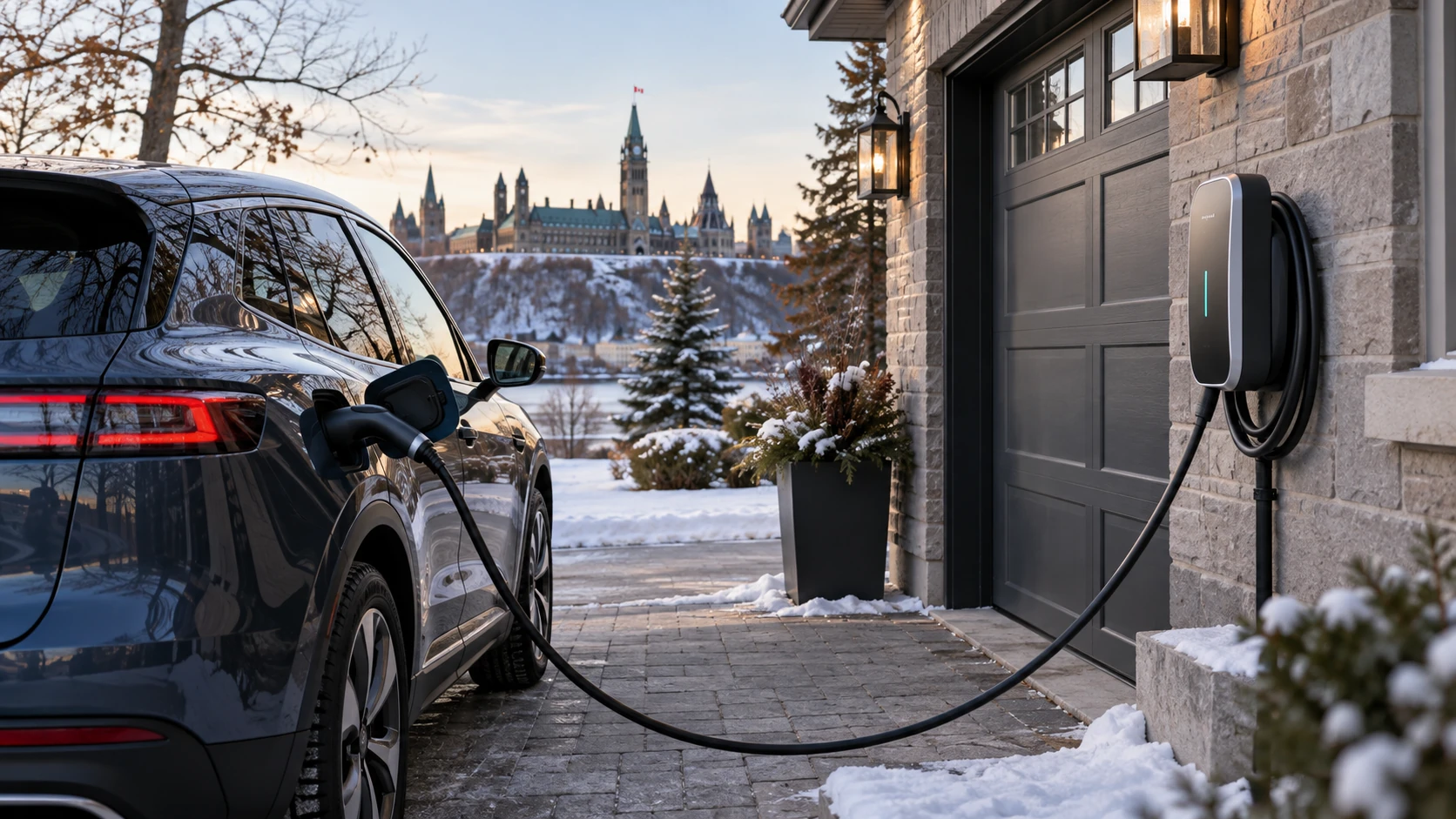
Installing a home EV charger in Ottawa is not simply a matter of mounting a charging box in the garage. The decisions that affect cost and safety are how much charging you need overnight, how much electrical capacity your home has, where the charging equipment will sit and who files the electrical notification. A qualified installer can often explain options short of a full 200-amp service upgrade.
The short version: Identify your actual daily driving and charging needs, ask an Ontario Licensed Electrical Contractor (LEC) for an electrical load assessment, select equipment approved for use in Canada, obtain the required Electrical Safety Authority (ESA) notification before installation, and keep your acceptance documents. See the ESA's EV charging guidance and Hydro Ottawa's home charging information.
Scope and date: Reviewed October 16, 2026. This guide concentrates on typical detached and townhouse home charging in Ottawa and neighbouring Ontario communities. Condominiums, shared parking facilities and commercial stations have additional ownership and electrical-design requirements.
1. Choose a charging level for your actual driving
An EV charging installation should begin with energy needs rather than the largest amperage advertised on a product page. A household that drives short distances and parks overnight may have different requirements from one that frequently returns with a nearly empty battery.
| Option | Common setting | Practical consideration |
|---|---|---|
| Level 1: 120-volt charging | Existing approved household charging arrangement | Slowest; may meet modest daily driving without a dedicated Level 2 installation |
| Level 2: 240-volt charging | Dedicated home EV charging circuit and equipment | Faster overnight charging; circuit size, wiring and capacity need professional assessment |
| Public DC fast charging | Trips and occasional high-speed charging | Different equipment and pricing; not a substitute for checking home needs |
Hydro Ottawa describes Level 1 and Level 2 charging and explains that Level 1 is substantially slower. Actual charging time depends on the vehicle, battery, state of charge and charging equipment. Do not assume a manufacturer's maximum charging rate is necessary—or supported by your vehicle.
Useful first calculation: Estimate a typical day's kilometres, how many hours the car remains parked, and whether you must charge two vehicles. Ask the contractor to translate that into a realistic charging-current option. The installer should use your vehicle and equipment specifications, not a generic guess.
2. Do you really need 200-amp electrical service?
No—not automatically. A 100-amp home can sometimes accommodate EV charging after a compliant demand/load calculation, a suitably sized charging circuit or an approved energy-management arrangement. Other homes need a service upgrade. A full breaker panel by itself does not prove that incoming capacity is inadequate.
The ESA's electric-vehicle charging bulletin addresses energy management and load-sharing, among other technical questions. Those are design options for qualified installers, not DIY shortcuts around the Ontario Electrical Safety Code.
| Home situation | Question for your LEC | Possible next step |
|---|---|---|
| 100-amp service, gas furnace and modest other loads | Does the demand calculation permit a dedicated charging circuit? | A smaller Level 2 circuit may be feasible |
| 100-amp service with electric heat, dryer and other heavy loads | What is the calculated demand with charging? | Load management or a service upgrade may be necessary |
| Panel has no free breaker spaces | Is this a space limitation rather than a capacity limitation? | Review a compliant panel or subpanel solution |
| Two EVs in the driveway | Can listed equipment coordinate or share charging capacity? | Evaluate load sharing and driving schedules |
| Rural home with private poles or long underground service | Who owns the conductors, and what can the distributor supply? | Obtain site-specific utility feasibility and cost information |
If you're comparing a service upgrade, read our separate BestOttawa guide, 100-Amp vs. 200-Amp Electrical Service: Ottawa Homeowner Guide, once it is published. Your LEC should document why the proposed design is permitted.
3. ESA notification and contractor licensing
Ontario's ESA says an EV charging installation requires an electrical notification—often called a permit—before work begins. If you're hiring a business to install the charging circuit, verify its ECRA/ESA Licensed Electrical Contractor status, not only an individual's trade certificate. The ESA homeowner EV factsheet describes these requirements.
Ask these questions before paying a deposit:
- What is your electrical contracting business's ECRA/ESA licence number?
- Who completes the home electrical load calculation?
- Who files the ESA notification, and is that fee included in the written quote?
- What circuits, protection and equipment are proposed?
- Who coordinates any inspection and supplies the final documentation?
The charging station itself should bear a recognized Canadian approval or certification mark. ESA advises homeowners not to rely on unapproved products bought online. A cheap charger is poor value if it cannot legally and safely be installed. Read ESA's consumer warning.
Plugging a portable charging cord into an existing receptacle is not the same job as installing a new dedicated receptacle or hardwired station. Do not assume that a dryer outlet, adapter, extension cord or any existing garage plug is appropriate for routine high-load charging.
4. Hardwired charger or receptacle?
Both approaches can be discussed with the installer, but the approved electrical design and equipment instructions control the decision. A hardwired EVSE avoids a user-accessible plug connection, while a receptacle-based setup introduces compatibility and receptacle/circuit questions.
| Comparison | Hardwired EVSE | Plug-in EVSE with dedicated receptacle |
|---|---|---|
| Connection | Direct permanent wiring | Approved plug and correctly installed dedicated receptacle |
| Flexibility | More permanent fixture | Easier to disconnect or move suitable equipment |
| Key installation checks | Disconnect provisions where required, protection and manufacturer instructions | Receptacle rating, matching plug, circuit protection and weather/location rules |
| What to demand in quote | Equipment, wiring, mounting and commissioning | Receptacle specification, wiring, protection and charger compatibility |
Ask the contractor whether the chosen location is damp, outdoors or subject to vehicle impact. ESA's technical guidance discusses mechanical protection of EVSE. A weather-rated outdoor charging station is not automatically safe if the cord path or mounting location is poorly planned.
5. Placement: driveway, garage and winter use
Ottawa winters introduce salt, drifting snow, ice and cable management concerns. Place the charger so a driver can park normally without stretching a cable across a sidewalk, door or walkway. Where two vehicles share a charger, account for their actual charge-port locations.
A useful site inspection covers cord reach, vehicle impact risk, water and snow exposure, wall condition, exterior penetrations, cable routing and the distance to the electrical panel. For a detached garage or driveway pedestal, trenching and underground services may add substantial scope. Do not trench before checking underground utilities and any required property permissions.
If an installation would involve a shared wall, condominium common property, apartment parking area or public right-of-way, confirm the applicable owner/condominium/municipal approvals separately. The basic homeowner ESA notification does not establish permission to use land that isn't yours.
6. How much does installing a home EV charger cost in Ottawa?
There is no independently verified single 2026 Ottawa installed-price average that covers a short garage run, a difficult detached-garage trench and a whole-house electrical service upgrade. Equipment price alone is not the project price, and estimates from individual installers are advertising, not a citywide survey.
Published pricing examples, not verified averages: Two Ottawa-area electrical-service websites currently advertise approximately $1,500–$3,500 for a standard installed Level 2 charging setup, with substantial increases for a full service upgrade, long wiring run or detached-garage trench. See Ottawa Electric Service’s 2026 pricing page and a separate 2026 Ottawa installation cost guide. These are commercial estimates, not a statistically verified median, guaranteed quote or evidence that your home must be upgraded to 200 amps. Get an on-site assessment.
| Cost component | What should be included in the quote |
|---|---|
| Charging hardware | Brand, model, connector compatibility, approval mark and warranty |
| Electrician's assessment | Service rating, load calculation, circuit design and panel condition |
| Wiring and circuit protection | Run length, routing, conduit, breakers and other required protection |
| Wall or pedestal installation | Mounting, impact protection, outdoor rating and weatherproofing |
| ESA notification | Who files, cost treatment and acceptance documentation |
| Extra site work | Trenching, concrete, drywall, garage restoration or panel changes |
| Service upgrade, if needed | Distributor coordination, meter/entrance changes and potential additional fees |
Obtain two or three itemized, site-specific quotes. Provide each installer the same information about the vehicle, desired charging schedule, panel location and parking arrangement. Comparing quotes for different charging currents and wiring routes without recognizing the differences is misleading.
7. Hydro Ottawa, Hydro One and charging electricity costs
Your electricity distributor is identified on your bill. A City of Ottawa mailing address does not mean Hydro Ottawa serves every property; rural and surrounding homes may be served by Hydro One or another distributor. Larger service changes may require utility involvement and coordination beyond the ESA notification.
Charging adds kilowatt-hours of energy use, not a fixed cost per charging session. A comparison of time-of-use, tiered or ultra-low overnight pricing should use your actual rate plan, delivery charges and driving pattern. A claimed universal Ottawa per-kilometre charging cost can be misleading.
Hydro Ottawa's EV information is a useful starting point for local charging concepts. Check your utility's current rate choices and billing details before estimating savings versus gasoline.
8. Safety issues that deserve attention
An EVSE is a substantial, recurring electrical load. Do not use extension cords, improvised dryer-outlet adapters, damaged charging cables or unapproved equipment. Arrange a proper assessment if the home has an older electrical service, aluminum wiring concerns, water damage or a deteriorated panel.
Stop charging and arrange professional assessment if plugs, receptacles or equipment show overheating, melting, unusual odours or repeated protective-device trips. Do not remove electrical-panel covers to diagnose a problem yourself. Installation and warranty documents should explain who services the charging station and who is responsible for the electrical wiring.
9. Installation sequence and documents to keep
- Record your vehicle's charging capability and normal driving needs.
- Ask a licensed electrical contracting business to inspect the proposed location and document electrical capacity.
- Compare a suitable charging-current option with any feasible load-management or service-upgrade alternatives.
- Choose Canadian-approved charging equipment compatible with the proposed circuit and outdoor conditions.
- Confirm pricing, site restoration, ESA notification and required property permissions in writing.
- Have the authorized contractor file the notification and perform the work.
- Ask for commissioning and an explanation of the charger's normal operation and limitations.
- Keep the final invoice, charger model/serial number, warranty and ESA Certificate of Acceptance after accepted work.
For a new car purchase, coordinate the charging installation well before delivery rather than assuming a high-power charger can be added in one visit.
10. Save this Ottawa EV-charger quote checklist
Before hiring:
- Verify the electrical business's ECRA/ESA licence.
- Identify the existing service rating, planned additional loads and available panel space.
- Decide how much overnight charging you need; don't automatically request the largest circuit.
- Ask about energy-management options if the calculated load is tight.
- Compare hardware certification, warranty, mounting and cable placement.
Before work starts:
- Confirm who files the ESA notification and handles any utility or property approvals.
- Get an itemized price that includes wiring, protection, site work and restoration.
- Have a winter-safe cable location and plan for any trenching.
After installation:
- Obtain the ESA acceptance document and detailed invoice.
- Test normal charging, scheduling and any load-management features with the installer.
- Retain manuals and confirm which contractor handles follow-up issues.
Editorial note (reviewed October 16, 2026): This guide provides general homeowner information, not electrical design. The ESA, your electricity distributor and a properly licensed electrical contracting business determine the requirements for a particular installation. Electrical codes, products and utility rates can change.
you asked
Common questions
Do I need an ESA permit to install an EV charger in Ontario?
Yes. ESA states an electrical notification is required before an EV charging installation begins. The licensed electrical contractor performing the work should arrange the notification and any applicable inspection. Simply using an existing approved charging cord is different from installing new wiring or a circuit.
Can I charge an electric car at home with a regular outlet?
Many vehicles support slower Level 1 charging with a manufacturer-approved cord on an appropriate circuit. Do not assume an old garage outlet, extension cord or improvised adapter is suitable. Ask an electrician if the circuit or receptacle condition is uncertain.
Do I need 200-amp service for a Level 2 charger?
Not automatically. The contractor must assess calculated demand, existing equipment and the proposed charging rate. Some 100-amp homes can use lower-current charging or approved energy-management arrangements; others require a service upgrade.
Is a hardwired EV charger better than a plug-in charger?
Neither is universally better. Hardwired and properly approved receptacle-based arrangements have different connection, protection, service and location requirements. Have a Licensed Electrical Contractor specify a compliant design for your equipment.
Who is allowed to install a home EV charging circuit in Ontario?
If you hire someone, verify the electrical contracting business has an ECRA/ESA Licensed Electrical Contractor licence. Individual trade certification alone is not the same as authorization to offer electrical contracting services to homeowners.
What affects home EV charger installation costs in Ottawa?
Two Ottawa-area commercial guides advertise roughly $1,500–$3,500 for standard installed Level 2 charging, but those are not verified local averages or quotes. Wiring, equipment, panel capacity, ESA notifications, site work and utility changes can make a project cheaper or substantially more expensive.
Can two EVs share a home charging circuit?
Compatible listed equipment and an appropriately designed load-sharing system may allow managed charging, subject to code and capacity assessment. Ask your installer to confirm the exact supported models, circuit design and operating limits.
Does Hydro Ottawa need to approve every EV charger?
An ordinary home charging circuit and a full electrical-service upgrade are different projects. Your electrician should confirm whether the planned work requires utility coordination. If a service upgrade is needed, the electricity distributor serving your property must be involved.
Can I put an EV charger outside in an Ottawa winter?
Outdoor installations are possible with equipment approved for the location and a compliant electrical design. Assess snow, water, freezing conditions, vehicle impact and cable routes before choosing the mounting position.
What records should I receive after EV charger installation?
Keep the invoice, equipment specifications and warranty, operating instructions and ESA Certificate of Acceptance after the notified work has been reviewed and accepted. Ask the installer who handles future equipment or wiring issues.
Sources
- Electric Vehicles and Charging Systems — Electrical Safety Authority
- EV Charger Factsheet — Electrical Safety Authority
- Electric Vehicle Charging Systems Bulletin 86-1-7 — Electrical Safety Authority
- ESA Ramps Up EV Charging Safety — Electrical Safety Authority
- EV Supply Equipment Safety Interview — Electrical Safety Authority
- Electric Vehicles and Home Charging — Hydro Ottawa
- EV Charging at Home — Hydro Ottawa
- Charging Electric Vehicles — Government of Ontario
- Ottawa EV Charging 2026 Contractor Price Example — Ottawa Electric Service
- Ottawa EV Installation 2026 Contractor Price Example — Electricians Ottawa
keep exploring
Related reading

Service category
Electricians in Ottawa: Hiring, Permits and Common Projects
An Ottawa-area starting point for hiring a Licensed Electrical Contractor, understanding common household projects and finding trustworthy ESA and utility guidance.
Homeowner guide
100-Amp vs. 200-Amp Electrical Service in Ottawa (2026): Upgrade Costs and Checklist
A practical Ottawa-area guide to evaluating home electrical capacity, planning a 100A-to-200A service upgrade, coordinating utilities and comparing contractor quotes.
Homeowner guide
Home Standby Generator Installation in Ottawa (2026): Costs, Rules and Checklist
An Ottawa-area homeowner guide to generator sizing, installation costs, transfer switches, ESA notifications, gas or propane work, City rules and contractor questions.
Homeowner guide
How to Hire a Licensed Electrician in Ontario: An Ottawa Homeowner’s Guide
An Ottawa-area homeowner checklist for verifying licensed electrical contractors, comparing written estimates and understanding ESA notifications and acceptance documents.