
a homeowner's field guide
100-Amp vs. 200-Amp Electrical Service: Ottawa Homeowner Guide
A practical Ottawa-area guide to evaluating home electrical capacity, planning a 100A-to-200A service upgrade, coordinating utilities and comparing contractor quotes.
13 min readEditorially reviewed
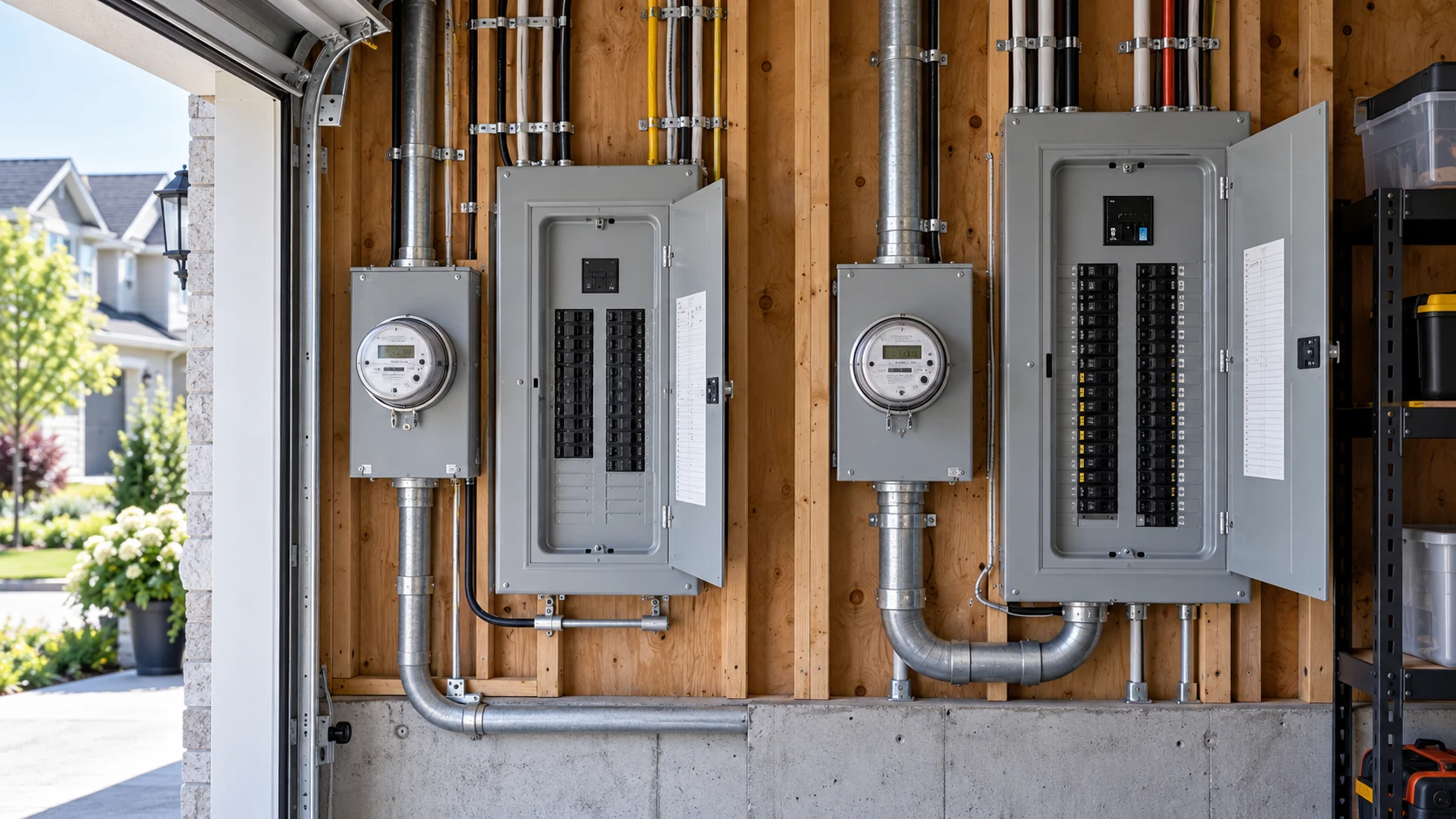
Before paying for a 200-amp electrical service upgrade, find out whether your Ottawa-area home actually needs more capacity. A full breaker panel, an EV charger, or plans for a heat pump do not automatically mean a 100-amp service must be replaced. The correct decision depends on a qualified assessment of your existing installation, a code-compliant electrical load calculation, the proposed new loads and your electricity distributor's requirements.
The short version: Ask an Ontario Licensed Electrical Contractor (LEC) to confirm the actual service rating and calculate demand for your current and planned equipment. Distinguish a panel replacement from an increase in incoming service capacity. If you need more capacity, coordinate an ESA electrical notification and a utility service-upgrade request before scheduling the disconnect, inspection and reconnection. Start with Hydro Ottawa's electrical service request instructions if that utility appears on your bill.
Scope and date: Reviewed October 16, 2026. This guide covers typical residential 120/240-volt service questions in Ottawa and nearby Ontario communities. It is not an electrical load calculation or site-specific design. Requirements, costs and scheduling vary by utility and property.
1. What is the difference between 100-amp and 200-amp service?
Amperage describes the rated current of an electrical service. A typical residential 120/240-volt, single-phase service supplies both 120-volt circuits and 240-volt loads. A 200-amp service can accommodate a larger calculated load than a 100-amp service when the entire service installation is properly rated and approved.
| Question | 100-amp service | 200-amp service |
|---|---|---|
| Rated service current | 100 amperes | 200 amperes |
| Simple 240-V arithmetic reference | 24 kVA (240 V × 100 A) | 48 kVA (240 V × 200 A) |
| Typical planning question | Can existing and proposed loads fit safely? | Is more capacity justified by the calculated demand? |
| EV charger or heat pump | May work if assessed demand and controls allow | Can offer more design headroom, but not unlimited capacity |
| Requires service replacement merely because the panel is full? | No | No |
| Electricity bill | You pay for energy and applicable charges, not automatically twice as much because of the rating | Same principle |
Important: The kVA figures are arithmetic illustrations, not permitted load calculations or promises that all that current can be continuously used. Applicable code rules, the mix of loads, equipment ratings and utility conditions control the design. Have an LEC document the calculation; do not determine safe loading by adding breaker-handle numbers or relying solely on the size printed on a replacement panel.
2. Panel upgrade, service upgrade or extra circuit: which job do you need?
Homeowners and some advertisements use “panel upgrade” and “service upgrade” interchangeably. They are different scopes. A new 200-amp-rated panel does not by itself change a 100-amp service into a 200-amp service.
| Proposed work | What changes | Does incoming service capacity automatically increase? |
|---|---|---|
| Add a dedicated branch circuit | Wiring and protection for one new load | No |
| Replace a damaged or obsolete panel | The distribution panel and related equipment as required | No |
| Add an appropriately designed subpanel | More distribution space for circuits | No |
| Upgrade 100A service to 200A | Approved service conductors/equipment, metering arrangements and often the panel; utility coordination | Yes, if the whole upgrade is approved and completed |
| Install a code-compliant load-management solution | Controls when selected equipment can draw power | Not necessarily; design may avoid a service increase |
A full panel can be a space problem, a capacity problem, both, or neither. An LEC can explain whether code-compliant circuit rearrangement, a new panel, a subpanel, load management or a service upgrade is appropriate. A damaged or unsafe panel may require repair regardless of calculated amperage.
For Hydro Ottawa-served homes, the utility's published ownership guidance identifies items such as the mast, meter base and wires from the meter base to the panel as homeowner responsibilities on typical overhead services, while the utility is responsible for the pole-to-home wires. Confirm the actual ownership boundaries with your distributor; never work on or near energized service equipment yourself. Hydro Ottawa explains typical service responsibilities.
3. When might an Ottawa home genuinely need 200 amps?
The trigger is a calculated demand or another actual system requirement, not simply the presence of one appliance. Ask for a written assessment when you plan several large loads, change heating sources or expand the dwelling.
| Homeowner scenario | What to ask the electrician |
|---|---|
| Install a Level 2 EV charger | What charging current is realistic, and can the existing service support it? |
| Switch from gas to electric space or water heating | What do the combined winter design loads look like? |
| Add a heat pump with resistance backup | How are auxiliary electric heating elements handled in the load calculation? |
| Add a hot tub, workshop equipment or electric range | Can the simultaneous design loads be accommodated? |
| Create a secondary suite or add living area | Does the enlarged dwelling need more capacity and other approvals? |
| Install solar, a battery or a standby generator | Do interconnection, protection, transfer equipment or future loads change the design? |
| Replace a 60A service or deteriorated service equipment | Is renewal required for capacity, safety, equipment condition or more than one reason? |
An EV charger is not an automatic 200-amp mandate. ESA says the additional EV charging load must be assessed and the work requires an electrical notification; Hydro One says a 100-amp home may need upgrading. Some projects can be designed around a smaller charger setting or an approved management arrangement, but feasibility must be determined by the LEC for that home. See ESA's EV guidance and Hydro One's electrical-service discussion.
4. How do you assess a home without guessing?
Start with the facts about the house. Your electricity bill tells you which utility supplies the account; it does not establish the physical rating of the service. An old panel label can also be misleading if equipment has been changed over the years.
A useful contractor assessment should document:
- Existing service and main disconnect rating. Identify what is actually installed, not merely the breaker count.
- Condition and ratings of the equipment. Look at the panel, service entrance, meter base, grounding/bonding, and any known deficiencies without the homeowner opening energized compartments.
- Current fixed loads. Space heating, water heating, range, dryer, air conditioning, pumps and other equipment.
- Future loads. EV charging, heat pump, secondary suite, shop, hot tub or other changes you realistically expect.
- Demand/load calculation. Ask for the applicable Ontario Electrical Safety Code calculation and an explanation of any diversity or management provisions.
- Distributor constraints. Confirm whether the utility will approve the planned service size and whether poles, lines, transformer capacity or underground works affect the design.
Photographs: You can take a photo of the closed panel door, visible labelling and accessible exterior service equipment from a safe location. Do not remove the dead front, open sealed compartments, touch exposed conductors or approach damaged utility lines to get better pictures.
5. Hydro Ottawa, Hydro One and rural property differences
The correct utility is the one serving the specific electrical account, not necessarily the one that covers most of the city or the nearest municipality. Some Ottawa-area homes are supplied by Hydro Ottawa, others by Hydro One, and nearby municipalities can have different distributors.
| If your bill is from... | Practical starting point | Special consideration |
|---|---|---|
| Hydro Ottawa | Electrical Service Request | Submit roughly 3–4 weeks before the planned project; await the customer layout and costs |
| Hydro One | Builders and Contractors / Service Upgrade | Ask about connection assessment, utility-side work and the schedule for an ESA-authorized reconnection |
| Another distributor | Contact the utility identified on your bill | Its application forms, timelines and fee arrangements may differ |
Hydro Ottawa says to submit a service request three to four weeks before work, expects to contact customers within 10 business days, and provides a customer layout setting out work and estimated utility costs. Its current page also states one free customer layout is available per property in a rolling 12-month period, with qualifications and extra charges possible. These are guidance figures, not a guarantee that service will be upgraded or reconnected within four weeks. Hydro Ottawa service requests.
Hydro One's service process also involves assessing the connection and coordinating required electrical authorization before connection. Its published metering guide advises customers to initiate upgrade discussions early in project planning. Hydro One builders and contractors · Retail metering standards (PDF).
Rural properties: A long overhead service, private pole line, buried conductor, long trench, detached garage, well pump or heat-pump backup load can materially change both the design and the cost. Verify equipment ownership and utility requirements rather than assuming an urban 100A-to-200A quote will apply in Carp, rural Ottawa, Beckwith, Mississippi Mills or Carleton Place.
6. How much does a 100A-to-200A service upgrade cost in Ottawa in 2026?
There is no verified, single Ottawa-wide installed price covering every service upgrade. The scope may range from a straightforward overhead service change to underground reconstruction requiring substantial utility and site work.
For orientation only, one Ottawa contractor advertises a $3,000–$6,000 CAD range for a typical 100A-to-200A service upgrade. That is a commercial advertisement from one provider, not an independently verified average, a municipal fee schedule or a quote for your home. A site-specific price can be lower or substantially higher. See the contractor's advertised example.
A written estimate is much more useful when it separates the real cost components:
| Cost component | What the estimate should clarify |
|---|---|
| Electrical assessment and load calculation | Is assessment included? What future loads are assumed? |
| Panel and circuit work | Does the quote include a new panel, breakers, surge protection and any corrections? |
| Service entrance and meter base | What mast, weatherhead, conductors, meter socket, grounding or bonding changes are required? |
| ESA notification / inspection | Who files it and are all applicable fees included? |
| Utility work | Are disconnect/reconnect, layout, line or transformer charges included or billed separately? |
| Underground or private-line work | Is trenching, conduit, restoration, pole access or excavation included? |
| Finished surfaces and access | Will drywall, siding, landscaping or driveway restoration be required? |
| Scheduling and contingency | What happens if utility approval or inspection causes a second visit? |
ESA reference fee: The 2026 ESA Wiring Fee Guide, Section 4.3.1, lists $86 for the contractor for certain new-service, service-change, repair or panel-change notifications for existing residential structures ($212 non-contractor). The guide flags certain fees with an asterisk and notes that other wiring or additional inspection visits can affect the charge. This is not the installed price, not a quote from ESA for your full project, and not necessarily the only ESA fee involved. Ask the contractor for the exact fee classification.
Hydro Ottawa separately supplies a customer layout with applicable utility costs; don't assume those charges equal the ESA fee or are already included in an electrician's advertised package. Hydro Ottawa service requests.
7. Electrical permits, inspections and reconnection
Ontario requires electrical notifications for almost all installation work. If you hire a contractor, use an ECRA/ESA Licensed Electrical Contractor and verify the business licence in ESA's directory. A person's trade certificate or Master Electrician status is not, by itself, a licence for the business to contract directly with homeowners. ESA hiring guidance.
ESA specifically identifies service upgrades, replacement and relocation as work requiring utility disconnection and a service inspection before power is restored. The contractor and utility need to coordinate this properly. Do not assume that passing a general final inspection later can replace the required service-stage authorization. ESA notifications and inspections.
Ask the contractor to confirm:
- Who files the ESA notification before work starts?
- Who submits the service request to your electricity distributor?
- Which equipment is homeowner-owned and which is utility-owned?
- When will the outage, ESA service review and utility reconnection occur?
- Is any additional rough-in or final inspection required for accompanying branch-circuit work?
- What happens if a defect is found or reconnection cannot occur on the planned day?
- How will you receive the final ESA Certificate of Acceptance and project records?
ESA explains that the Certificate of Acceptance is issued to the notification holder after work has been reviewed and accepted. If the contractor filed the notification, request a copy for your records. ESA Certificate of Acceptance.
Safety: Never pull the utility meter yourself, bypass seals, modify live service equipment, or attempt to arrange an unsafe informal reconnection. For exposed wires, smoke, sparking or severe equipment damage, keep away and contact the appropriate emergency/utility services.
8. What the installation timeline actually looks like
A normal project may involve a relatively short period of physical electrical work after the design and utility coordination have been completed. The total scheduling period is not the same as the installation-day outage. Hydro Ottawa recommends allowing 3–4 weeks just for advance submission of its service request, and actual lead times can be longer.
| Stage | What should be complete before moving on |
|---|---|
| Assessment | Existing rating, equipment condition and calculated future demand documented |
| Scope and estimate | Itemized electrical work, utility charges and responsibility for approvals clarified |
| Utility request | Distributor reviews proposed capacity, layout, applicable costs and scheduling |
| ESA notification | LEC files the notification and arranges required inspection stages |
| Scheduled disconnection | Power is isolated by authorized personnel; homeowner plans for outage |
| Electrical work and inspection | New service equipment installed and the required ESA service authorization obtained |
| Reconnection and testing | Utility reconnects when authorized; circuits and equipment are tested |
| Handover | Homeowner receives ESA acceptance paperwork, final invoice, circuit schedule and warranties |
If you depend on a well pump, electrically driven sump pump, medical equipment, security system or working-from-home internet, plan for the scheduled outage and the possibility of delays. An electrical service upgrade does not, by itself, provide backup power during an outage.
9. Can you avoid upgrading to 200 amps?
Sometimes. A qualified design may meet household needs without increasing the incoming service, especially when the original issue is panel space rather than load. Options to discuss include:
- A properly assessed lower-current or adjustable Level 2 EV charger, where supported and permitted.
- A code-compliant EV charging load-management arrangement designed for the existing service.
- A replacement panel or subpanel where additional breaker spaces are needed but the service rating is adequate.
- Adjusting planned appliance choices or the sequence of renovations to fit a documented capacity plan.
- Completing the service upgrade now if the documented future-load calculation shows it is genuinely needed.
None of these options is universally suitable. Equipment certification, electrical code, manufacturer instructions and service conditions matter. Ask the LEC why the recommended option passes the load calculation and what future expansion it leaves available.
Example decisions — not automatic approvals
| Household plan | Sensible first step |
|---|---|
| 100A house, gas heating, wants an EV charger | Calculate existing and added load; compare charging-current and management options |
| 100A house, converting to major electric heating loads | Recalculate entire demand, especially resistance backup and water heating |
| 100A house, main panel full but loads are unchanged | Check panel suitability and distribution-space options before ordering a full service upgrade |
| Rural house, long underground service, multiple new loads | Request utility feasibility and line/site estimates early |
10. Comparing Ottawa electrician quotes: homeowner checklist
Give two or three Licensed Electrical Contractors the same project description wherever practical. Otherwise, the apparent lowest bid may omit the most expensive parts of the work.
Before requesting prices:
- List every new load planned over the next few years: EV, heat pump, hot tub, induction range, suite or workshop.
- Identify your actual distributor from your electricity bill.
- Provide safe photos of the closed panel, its visible labelling and the exterior service entrance.
- Mention overhead/underground supply, private poles, buried utilities and access constraints.
- Ask for an on-site or otherwise sufficiently documented electrical assessment and load calculation.
Before accepting a quote:
- Verify the electrical business's ECRA/ESA licence using the official ESA guidance.
- Confirm whether it is a panel replacement, service upgrade or both.
- Require an itemized breakdown of panel, mast/meter, service conductors, grounding, ESA fees and utility coordination.
- Ask the contractor to explain the load calculation and why the recommended amperage is suitable.
- Agree who pays utility customer-layout and connection charges, excavation and restoration.
- Confirm the planned outage, service inspection, reconnection and any contingency for a delayed restoration.
- Check materials, warranties, insurance and how unexpected conditions or change orders will be handled.
After completion:
- Request the ESA Certificate of Acceptance and any utility connection/authorization records supplied to the homeowner.
- Keep the final invoice, updated panel directory, product information and warranty documents.
- Save the load-calculation summary for future EV, heating or renovation decisions.
Official starting points: Hydro Ottawa service requests · Hydro One connection and upgrade information · ESA electrical inspections.
Editorial note (reviewed October 16, 2026): This homeowner guide provides general information rather than electrical engineering design or legal advice. The qualified contractor and electricity distributor must determine your home's applicable capacity, equipment, approvals and cost. Published contractor prices are illustrative advertisements, not verified Ottawa averages; fees and processes can change.
you asked
Common questions
Is 100 amps enough for a house in Ottawa?
It may be. Existing equipment, future loads and the code-compliant demand calculation determine whether 100A is adequate; house size or breaker count alone does not answer the question. Ask a Licensed Electrical Contractor to assess your actual service.
Do I need 200-amp service to install an EV charger?
Not automatically. An LEC must assess available electrical capacity and the proposed charging load. A smaller charging current or an approved energy-management arrangement may sometimes work on 100A; some homes will need a service upgrade. ESA requires notification for the installation.
Does a 200-amp breaker panel automatically give me 200-amp service?
No. The incoming conductors, service equipment, main overcurrent protection, meter arrangement and distributor connection must be appropriately rated and approved. Merely installing a larger-rated panel does not increase the approved service capacity.
What does a 100A-to-200A service upgrade cost in Ottawa in 2026?
There is no verified universal local average. One Ottawa electrical contractor advertises roughly $3,000–$6,000 for a typical upgrade, but actual site-specific quotes may be much higher depending on utility work, underground supply, panel relocation and repairs. Compare itemized proposals.
How much is the ESA fee for a service upgrade in 2026?
The 2026 ESA Wiring Fee Guide Section 4.3.1 lists $86 for contractor-filed consumer-service work in its applicable category and $212 non-contractor, with conditions and possible additional fees. That is an ESA reference fee, not the installed cost or necessarily every fee for the project.
Do I need Hydro Ottawa involved when upgrading from 100 to 200 amps?
If Hydro Ottawa is your distributor, yes: the service connection must be assessed and disconnection/reconnection coordinated. Hydro Ottawa asks for a service request 3–4 weeks ahead and provides a customer layout with costs. Other distributors such as Hydro One have their own requirements.
How long does a 200-amp upgrade take in Ottawa?
The physical service work may be completed in a workday on a straightforward project, but the end-to-end schedule depends on utility review, equipment, ESA inspection and reconnection. Hydro Ottawa recommends submitting requests at least 3–4 weeks ahead; this is not a guaranteed completion time.
Can I upgrade only the electrical panel and keep my 100-amp service?
Potentially. A panel replacement or subpanel may solve a damaged-equipment or breaker-space issue without increasing service capacity, but an electrician must assess ratings, demand and code requirements. It cannot solve a genuine service-capacity shortfall on its own.
Will a 200-amp service double my electric bill?
Not merely because of the new rating. Electricity bills depend largely on energy consumed and applicable delivery, regulatory and other charges; a larger service rating allows more potential capacity but does not itself mean you use twice as many kilowatt-hours.
What paperwork should I get after a 200-amp service upgrade?
Ask your LEC for the ESA Certificate of Acceptance, the final detailed invoice, a labelled panel schedule, warranty and equipment information, and any relevant utility records or load-calculation summary. ESA issues the Certificate of Acceptance after notified work has been reviewed and accepted.
Sources
- Electrical Service Requests: Process and Customer Layouts — Hydro Ottawa
- Electric Vehicles and Home Charging — Hydro Ottawa
- Distribution System Design and Customer Layouts — Hydro Ottawa
- Builders and Contractors: New Connections and Upgrades — Hydro One
- Retail Metering Standards: Applications for New Connections or Upgrades — Hydro One
- Electric Vehicle Charging and Electrical Service Size — Hydro One
- Notifications and Inspections: What You Need to Know — Electrical Safety Authority
- Hiring a Licensed Electrical Contractor — Electrical Safety Authority
- ESA Certificate of Acceptance — Electrical Safety Authority
- Electric Vehicles and Charging Systems — Electrical Safety Authority
- 2026 ESA Wiring Fee Guide: Consumer Service, Section 4.3 — Electrical Safety Authority
- Ottawa 100A-to-200A Upgrade Advertised Price Example — True Beacon (electrical contractor)
keep exploring
Related reading

Service category
Electricians in Ottawa: Hiring, Permits and Common Projects
An Ottawa-area starting point for hiring a Licensed Electrical Contractor, understanding common household projects and finding trustworthy ESA and utility guidance.
Homeowner guide
Home EV Charger Installation in Ottawa (2026): Costs, Capacity and ESA Requirements
An Ottawa homeowner guide to safe Level 2 charging, electrical capacity, ESA notifications, utility questions and contractor quotes.
Homeowner guide
Home Standby Generator Installation in Ottawa (2026): Costs, Rules and Checklist
An Ottawa-area homeowner guide to generator sizing, installation costs, transfer switches, ESA notifications, gas or propane work, City rules and contractor questions.
Homeowner guide
How to Hire a Licensed Electrician in Ontario: An Ottawa Homeowner’s Guide
An Ottawa-area homeowner checklist for verifying licensed electrical contractors, comparing written estimates and understanding ESA notifications and acceptance documents.