
a homeowner's field guide
Ottawa Sump Pump & Backwater Valve Rebates in 2026
A step-by-step Ottawa homeowner guide to the Residential Protective Plumbing Program: 2026 rebate limits, eligibility dates, required permits and application records.
11 min readEditorially reviewed
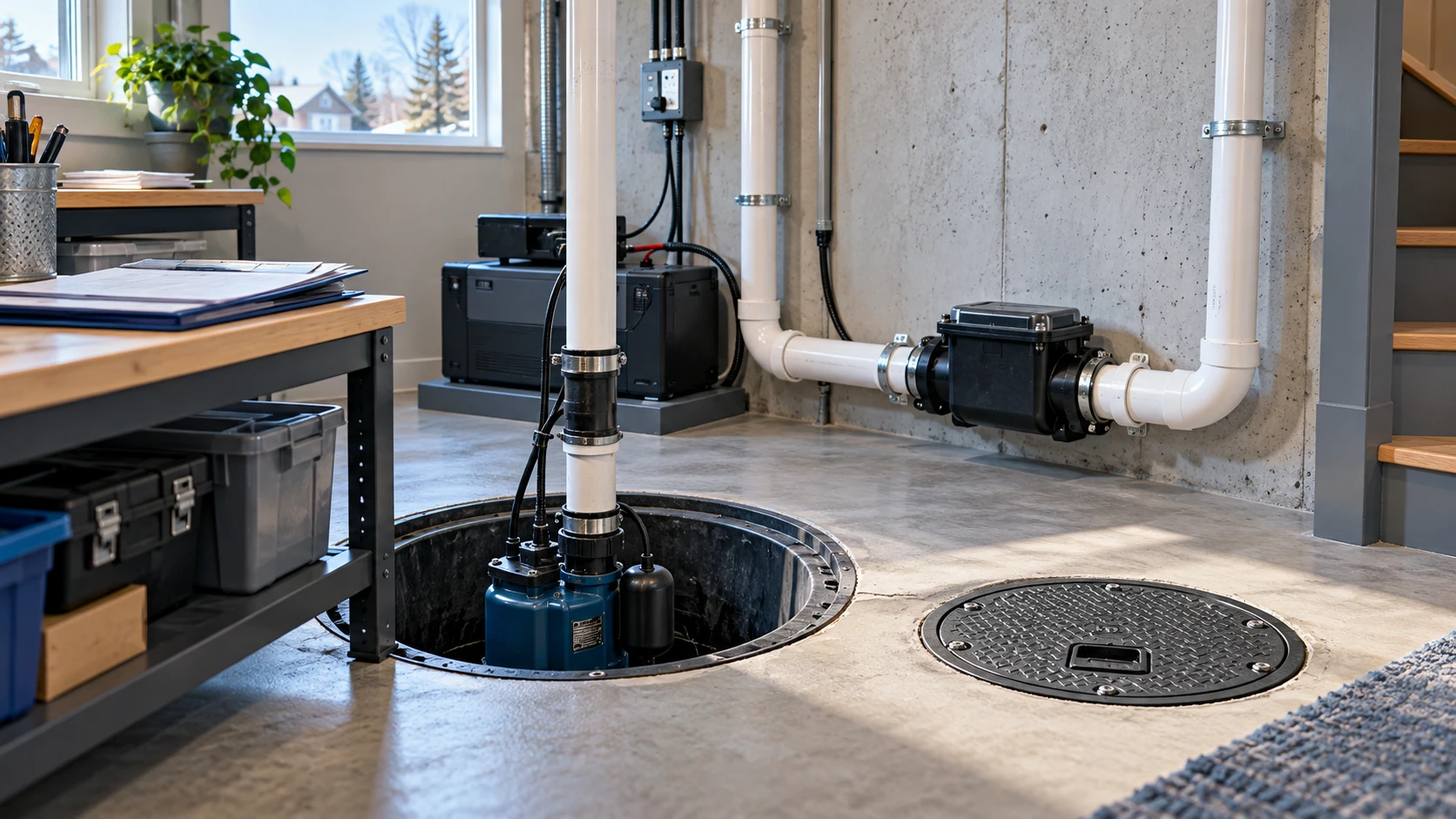
Ottawa homeowners considering a sump pump or backwater valve may qualify for money back through the City's Residential Protective Plumbing Program (RPPP). This is a rebate for eligible flood-prevention installations, not a blanket reimbursement for basement water damage. The amount depends on the device, the work completed, eligible costs and the City's approval.
The short version: Check your property's municipal boundary and construction date, ask a qualified plumber what protection your drainage system actually needs, obtain the required permit before work starts, keep the inspection report and paid itemized invoice, and apply through the City of Ottawa's RPPP page. As of October 15, 2026, that page says the deadline was extended to 18 months from the building-permit issue date, effective July 1, 2026. Confirm how the rule applies to your project before relying on it.
1. How much can Ottawa homeowners get back in 2026?
The City's current program page publishes the following maximum rebates. They are ceilings, not guaranteed payments. For each eligible item, the City pays the lesser of the applicable limit or the eligible cost of the work. Installation, property eligibility, permitting, application completeness and program funding still matter.
| Eligible device or expense | City's published maximum |
|---|---|
| Building permit for eligible plumbing work only | 100% of current permit fee |
| Indoor sanitary backwater valve | $1,000 |
| Storm backwater valve | $1,000 |
| Outdoor storm backwater valve | $2,500 |
| Primary sump pump with battery backup, installed in an existing pit | $1,500 |
| Secondary sump pump with battery backup, installed in an existing pit | $1,500 |
| Primary sump pump with battery backup, with construction of a sump pit | $3,000 |
| Secondary sump pump with battery backup, with construction of a sump pit | $3,000 |
Important: The values above are per listed eligible item, not a single promised rebate for every address. The City must determine what qualifies; do not simply add together every line of the table or assume both pump categories will be approved on one project. A battery-backup-free pump does not match the sump-pump descriptions in the published rebate schedule. See the City's current program and amount table and Residential Protective Plumbing By-law.
The permit-fee rebate covers the applicable plumbing permit fee, not an unrelated building permit or every renovation expense.
2. A practical eligibility check before you get quotes
Work through these questions before committing to an installation:
- Is the address inside the City of Ottawa? The City's program is for residential units within its municipal boundaries. A house in Kanata, Orléans, Barrhaven, Manotick or rural Ottawa may meet that geographic test. An address in Carleton Place or Mississippi Mills is not in the City of Ottawa, even if a contractor serves the wider Ottawa area.
- How old is the property, and which drain is involved? The City lists a before January 1, 2004 construction cutoff for stormwater backwater-valve work and before January 1, 2012 for sanitary backwater-valve work. Check which rule applies to the proposed installation. For sump-pump projects, especially newer or rural homes, ask the City to confirm your eligibility rather than assuming the backwater-valve cutoffs work differently.
- Is this new protective plumbing? Maintenance, repair and replacement of existing protective devices are not rebated under this program. An existing pump that merely needs repair is not the same as an eligible new installation.
- Is the installation being arranged by the owner, rather than the City? Work installed by the City itself is excluded by the published eligibility rules.
- Are required permits and inspections part of the plan? The City's backwater-valve permit guidance and program instructions call for permit and inspection documentation. Do not start permit-required work before obtaining the permit.
- Have you checked for previous rebates or overlapping assistance? The by-law notes previous applications tied to a property may affect eligibility; it also restricts reimbursement where other municipal or provincial assistance has already been approved for the same work.
Example situations — not eligibility approvals
| Example property | What to check |
|---|---|
| Ottawa home built in 1998; considering an indoor sanitary valve | Within the City's listed sanitary construction-date window, but confirm existing devices, scope, permit and all other conditions |
| Ottawa home built in 2010; considering a storm valve | Outside the listed pre-2004 stormwater cutoff; do not assume the storm-valve rebate applies |
| Ottawa home built in 2010; considering a sanitary valve | Within the listed pre-2012 sanitary cutoff; other program requirements still apply |
| Newer rural Ottawa property; considering a sump-pump backup | Confirm drainage design, geographic eligibility and pump-specific rules with the City before ordering equipment |
| Carleton Place home; considering either device | Not eligible for this City of Ottawa rebate because it is outside city boundaries; check programs offered by the applicable municipality or other organizations |
A homeowner does not need to self-diagnose sewer hydraulics. The most useful first step is to ask a qualified plumber to identify the flood pathway and confirm the proposed protective device is suitable.
3. Sump pump or backwater valve: which problem does each address?
A backwater valve helps prevent water or sewage in a surcharged sewer line from flowing backward into a house. Under ordinary conditions, the valve allows drainage out; during a backup it closes to reduce reverse flow.
A sump pump collects water from a sump pit, commonly fed by foundation drainage, and moves it to an approved discharge location. A secondary pump is backup capacity if the primary pump fails or cannot keep up. Battery backup helps maintain pumping during a power interruption, but it has limits and must be sized and maintained correctly.
| If the issue is ... | The device to discuss with a qualified plumber |
|---|---|
| Sewer water backing up through basement fixtures or drains | Appropriate sanitary or storm backwater valve, depending on the service |
| Foundation-drain water collecting in a sump pit | Properly sized sump pump and approved discharge route |
| Power outages during heavy rain | Battery backup and possibly a secondary sump pump |
| Water entering through foundation cracks, window wells or surface runoff | Grading, drainage and envelope repairs may be needed; a valve alone is not a solution |
The City's protective-plumbing FAQ explains both devices and specifically warns that protective plumbing cannot prevent every source of basement flooding. During a backwater-valve closure, avoid using plumbing fixtures until the valve is no longer engaged; wastewater may have no normal path out.
Safety: Do not open electrical equipment, enter dangerous floodwater or attempt to modify drainage connections yourself. Have appropriate professionals assess hazardous conditions. See Ontario's flooding safety guidance.
4. What changed in Ottawa's rebate program?
The City replaced its earlier protective-plumbing rules with By-law 2025-89, effective April 1, 2025. It described improvements that included higher rebate amounts, additional eligible items and simpler administration. The City's summary says it removed a previously required CCTV sewer inspection and external consultant review, and replaced the old two-part application process with a single application. That is why older downloadable forms or third-party instructions may be misleading. Use the current program page, not an archived application that cites the repealed 2016 by-law. See the City's by-law review summary.
Deadline update (July 1, 2026): The City now explicitly says work completion and receipt of a rebate application were extended from 12 to 18 months, effective July 1, 2026. However, the same page still contains older 12-month wording, and the online by-law text may not reflect every later administrative update. For an older permit or an application near the deadline, get written confirmation from protectiveplumbing@ottawa.ca of the date that applies to your permit. Do not assume an extension automatically revives every expired application.
5. How to apply, step by step
The City describes a post-installation application supported by permit, inspection and payment records. Because legal/by-law provisions and older materials may differ in how they describe initial approval, confirm the current application sequence with the City before signing an expensive contract, especially if your project has unusual eligibility questions.
- Check the address, construction year and proposed work against the program rules. Contact the City if anything is uncertain.
- Get a written diagnosis and itemized quote from a qualified plumber or contractor. Ask which particular rebate line the quote appears to match.
- Obtain the required building/plumbing permit before construction. Confirm who applies, which inspections are required and who schedules them.
- Have the work completed and inspected. Arrange the relevant City Building Code Services inspection and keep the resulting report. Keep product documentation and installation details.
- Pay the contractor and obtain an itemized paid invoice. It should identify the exact protective devices and eligible work instead of just saying “basement plumbing.”
- Apply through the City's current program page. Gather proof of property ownership, the building permit, the Building Code Services inspection report and the paid itemized invoice. Follow the City's current online or printable application instructions.
- Submit before the applicable deadline and retain confirmation of submission. The City's published update says 18 months from the permit issue date effective July 1, 2026; ask the program team to confirm which deadline governs your specific project.
Official starting point: City of Ottawa — Residential Protective Plumbing Program. The City's published contact email is protectiveplumbing@ottawa.ca; Ottawa residents may also use 3-1-1 for municipal service guidance.
6. The documents to collect before submitting
Use this as a practical filing checklist. The City's application page lists the core attachments; additional records may help if questions arise.
| Document | Why it matters |
|---|---|
| Proof of property ownership | Establishes that the applicant owns the eligible property |
| Building permit issued before the work | Documents approval for permit-required work and helps establish the deadline |
| City inspection report | Supports code-compliant completion of the permitted installation |
| Paid, itemized contractor invoice | Shows what devices and work were installed and the amount paid |
| Equipment model numbers and manuals | Helps identify what was installed and how to maintain it |
| Photos of the finished installation, if safely obtainable | Useful reference for future maintenance or questions, but not a substitute for required paperwork |
| Written email about unusual eligibility or deadline questions | Keeps a record of any City clarification specific to the property |
Avoid relying on an estimate alone: the City asks for paid invoice documentation when applying for the rebate.
7. Questions to ask when comparing plumber quotes
Give contractors the same description of the problem and ask for written answers to the following:
- Is the suspected flooding pathway sanitary sewer, storm sewer, foundation drainage or surface infiltration?
- Which protective device and exact type will be installed, and why?
- Does the proposed sump-pump package include battery backup power, as specified in the rebate table?
- Is a new sump pit being constructed, or is the work in an existing pit?
- Are permit fees, inspections, concrete cutting and reinstatement, excavation, electrical work, discharge routing and cleanup included?
- Who applies for the permit and requests the final inspection?
- Will the invoice separate equipment and work so the City can assess eligible items?
- What ongoing maintenance, accessibility and warranty arrangements apply?
- Will the work affect other basement plumbing while a backwater valve is closed?
- Will you supply the inspection record, product model details and a fully paid invoice?
Do not treat the published rebate limit as a contractor's market price. The program page reports maximum assistance, not typical installation costs. Compare the actual scopes of at least two or three properly qualified contractors where practical.
8. What the rebate does not pay for — and what it cannot prevent
The program is intended for qualifying protective-plumbing installation. According to the City's rules, it is not a rebate for routine maintenance, repairing or replacing existing protective devices. Do not assume it will cover unrelated foundation restoration, landscaping, finished-basement repairs or flood cleanup. Review the eligible scope with the City before including peripheral work in an application.
Backwater valves and sump pumps require ongoing attention. The City's prevention guidance recommends checking protective devices periodically and before forecast heavy rainfall and following manufacturer instructions. A clogged valve, failed pump, exhausted battery or poor drainage elsewhere on the lot can still leave a home vulnerable.
If your basement already flooded, the Residential Protective Plumbing Program is different from the City's Compassionate Grant Program, which has separate rules for qualifying flooding damage. Do not confuse an installation rebate with emergency financial assistance. See the City's separate flooding-grant guidance.
9. Ottawa boundary matters — including for rural homes
Some residents call themselves “Ottawa-area” homeowners even when they live in another municipality. The RPPP is specifically a City of Ottawa program. A rural house inside Ottawa's limits may have a different drainage arrangement from a house connected to urban sanitary and storm sewers; that is a reason to confirm suitability and eligibility with the City and a qualified contractor, not a reason to assume every rural home qualifies.
For owners in Carleton Place, Mississippi Mills and other municipalities outside Ottawa, the City of Ottawa's listed rebate is not available simply because the contractor or mailing address uses “Ottawa.” Check your own municipality for any applicable local programs.
10. Save this homeowner action list
Before the work:
- Confirm the municipal boundary, house construction year and proposed device.
- Check the City's current eligibility requirements and clarify ambiguous cases by email.
- Ask for an itemized contractor quote and identify permit and inspection responsibilities.
- Obtain the required permit before starting.
After the work:
- Keep the final permit, inspection report and paid itemized invoice.
- Check the 18-month announcement against the deadline applicable to your permit.
- Submit through the official RPPP application page; retain confirmation.
- Schedule maintenance of the valve, pump and battery backup according to manufacturer instructions.
Editorial note (reviewed October 15, 2026): This guide summarizes published municipal guidance. It does not determine an individual property's eligibility, guarantee funding or replace a permit or professional plumbing assessment. Program limits, forms and deadlines can change; the City makes the final determination. The July 2026 18-month notice appears alongside older 12-month text on the City's site, so confirm time-sensitive cases directly with the program team.
you asked
Common questions
How much is Ottawa’s backwater valve rebate in 2026?
The City lists a maximum of $1,000 for an indoor sanitary backwater valve or storm backwater valve, and $2,500 for an outdoor storm backwater valve. Payment is limited by actual eligible costs and approval; check the City’s current RPPP page.
Can I get $3,000 for a sump pump in Ottawa?
The City lists up to $3,000 for a qualifying primary or secondary sump-pump installation with battery backup and construction of a sump pit. A qualifying battery-backed pump in an existing pit has a published maximum of $1,500. These are caps, not automatic payments.
What is the RPPP application deadline in October 2026?
Ottawa says that effective July 1, 2026 the deadline for completing the work and submitting an application increased from 12 to 18 months from the building permit issue date. Because older 12-month language remains on official pages, confirm which deadline applies to your permit with the City.
Do I need a permit to install a backwater valve or sump pump?
The City’s protective-plumbing guidance requires appropriate building/plumbing permits and inspection documentation for rebate applications. Obtain any required permit before starting work and confirm the exact permits for your installation with Building Code Services.
Does a house built in 2010 qualify for Ottawa’s backwater valve rebate?
The City lists a pre-2012 cutoff for a sanitary backwater valve, but a pre-2004 cutoff for stormwater work. Thus a 2010 home may meet the sanitary construction-date criterion but not the stormwater one. All other eligibility and work conditions still apply.
Is the City of Ottawa rebate available in Carleton Place or Mississippi Mills?
No. The Residential Protective Plumbing Program is for qualifying residential properties within City of Ottawa boundaries. Carleton Place and Mississippi Mills are separate municipalities.
Will Ottawa reimburse replacement of a broken sump pump or existing backwater valve?
The City expressly excludes maintenance, repair and replacement of existing protective plumbing devices. Ask the program team if your proposed scope includes both new eligible equipment and non-eligible replacement work.
Do I have to experience flooding before I can apply?
The City presents the RPPP as a preventive program, and a prior flooding event is not a stated prerequisite in its published eligibility list. Your property, proposed installation, permit and paperwork must still satisfy all applicable conditions.
Can I apply without a paid contractor invoice?
The City lists a paid, itemized installation invoice among the required rebate application documents, together with ownership evidence, the permit and an inspection report. An unpaid quote by itself is not equivalent.
Sources
- Residential Protective Plumbing Program: Eligibility, Rebates, Deadlines and Apply — City of Ottawa
- Residential Protective Plumbing By-law No. 2025-89 — City of Ottawa
- Residential Protective Plumbing By-law Review and 2025 Program Changes — City of Ottawa
- Residential Protective Plumbing Frequently Asked Questions — City of Ottawa
- Backwater Valves — Building Permit Guidance — City of Ottawa
- How to Prevent Basement Flooding — City of Ottawa
- Compassionate Grant Program (Separate Flood-Damage Assistance) — City of Ottawa
- Floods: Preparedness, Safety and Recovery — Government of Ontario
keep exploring
Related reading
Homeowner guide
Basement Flood Prevention in Ottawa: Sump Pumps, Backwater Valves and Drainage
An Ottawa homeowner diagnostic and maintenance guide to foundation drainage, sewer backup, sump pumps and flood-risk reduction.

Service category
Plumbing in Ottawa: Repairs, Sump Pumps and Flood Protection
A practical guide to residential plumbing needs in Ottawa, from everyday leaks to basement water problems and protective plumbing projects.